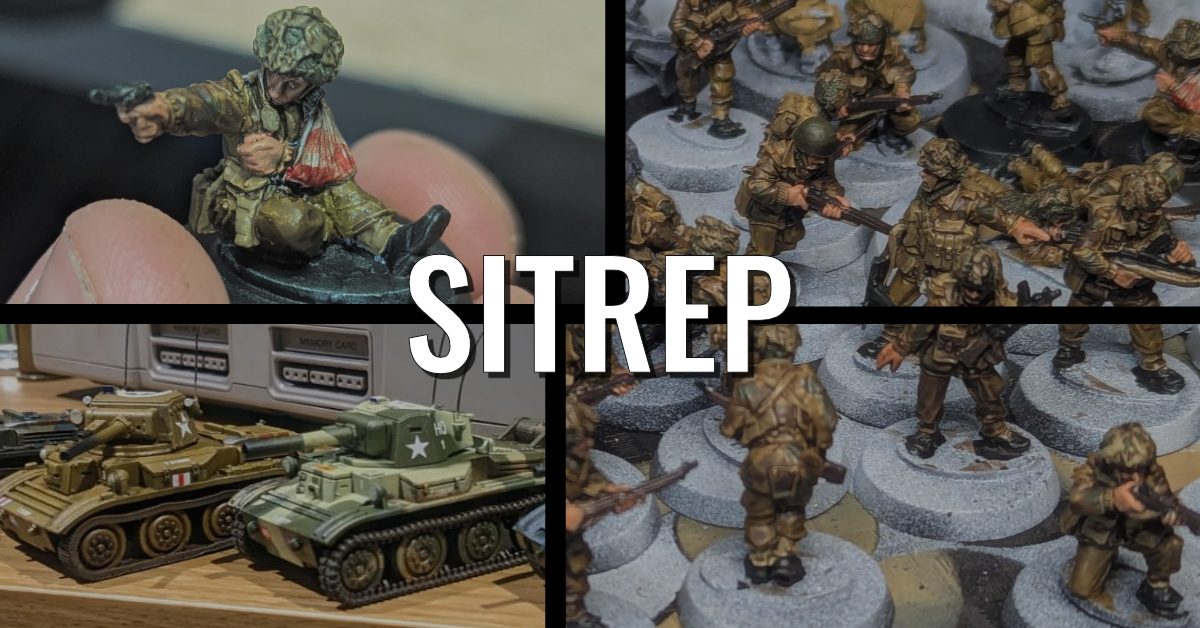
Every February, York hosts Vapnartak, the first major wargames show of my calendar each year. However, more importantly, the Regular Opponents and I have used this event as an excuse to run a big game. In the past, we’ve seen large What A Tanker and our massive (and spooky) Chain of Command game. Deciding to stick with the theme we’ve been making, the plan for this year was to run a large game of Chain of Command V2, playingthe new rules after our initial game went as well as it did. The question, however, was where to set the game.
Well, seeing as the Dastardly Regular Opponent has been reading books all about the British Airborne on D-Day, and seeing as that between us we have a company of Paras, it made sense to play something from Operation Tonga. We settled on the defence at Ranville, giving a chance for the aggressive paras to dig in and defend against assaulting German forces. The plan was also to play using the Big CoC rules that came out around Christmas, playing a deep and wide game – multiple platoons on multiple phaselines. We also decided to play around with adding in some armour (we do enjoy playing with all the toys) – the Germans would have a Panzer 4 platoon and a scattering of Stugs and armoured cars (fitting for an armoured counterattack). The British, on the other hand, historically didn’t have armour at this point, dealing with the tanks with 6 Pounder AT guns and PIAT teams.
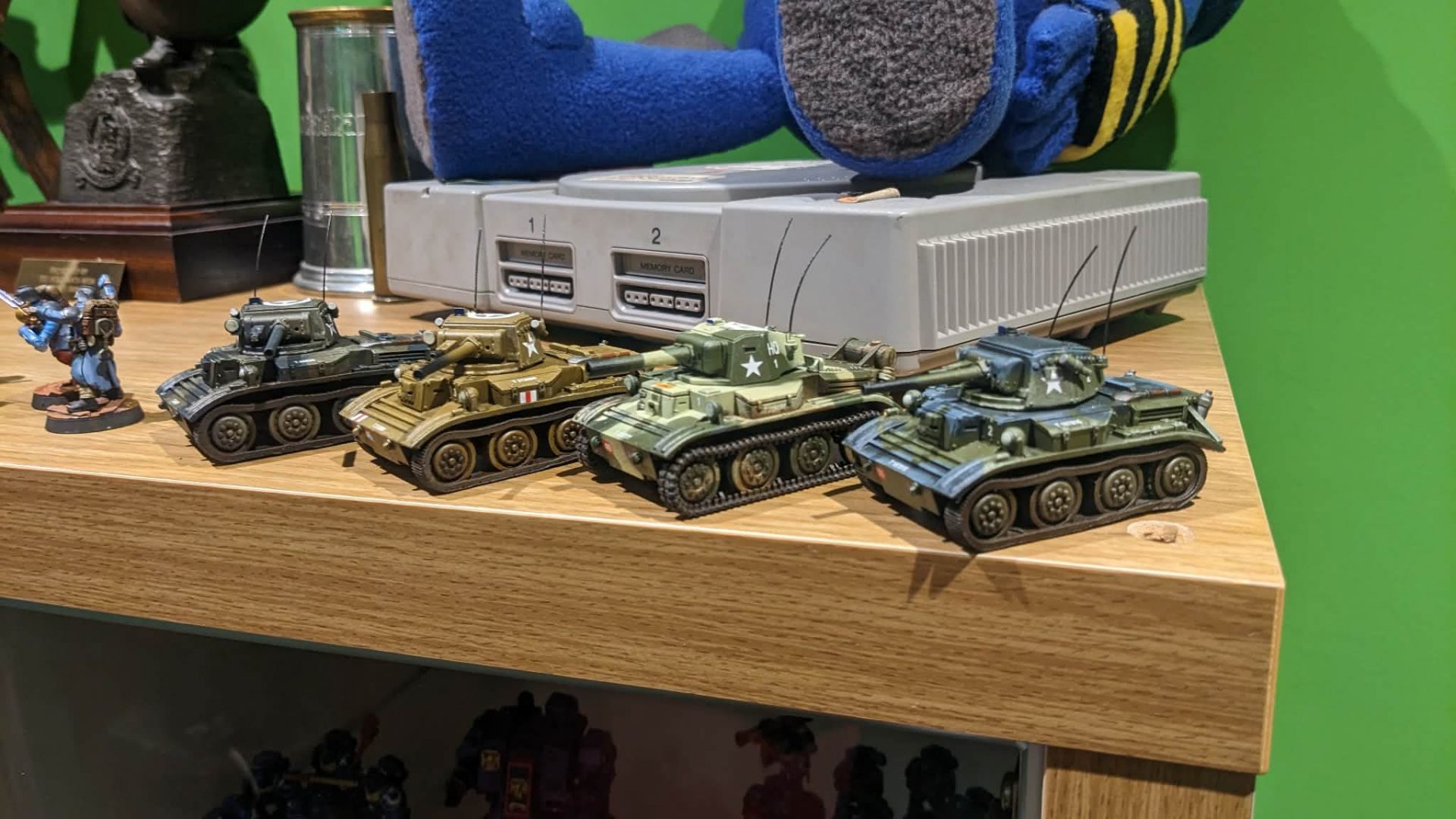
However, the Corporate Regular Opponent has been playing with his HeyGears 3D printer and printed off a platoon of Tetrarchs, the air-portable light tank much beloved by all Company of Heroes players from its glider-based deployment back in the day. On paper, the Tetrach is kind of terrible – lightly armoured and only equipped with a light AT gun with no HE round and a coaxial machine gun (the close support version is marginally better thanks to actually having some cover-defeating HE). In fact, based on calculations for an armoured platoon in Big CoC, a Tetrach platoon is actually in the negatives, below the value of a regular paratrooper platoon. However, I am very interested in seeing how effective a light armour platoon can be – it’s going to struggle against armour in head-on engagements, and the lack of HE and a single MG turns it into barely more than a Bren gun in a pillbox, but there is some potential due to its fast speed. It also helps that the tanks look incredibly cool and, as you can see above, the Corporate Regular Opponent has knocked it out of the park, painting up his Tetrachs with a mixture of British WW2 camo – not the most historically accurate, but I know he had a lot of fun painting them.
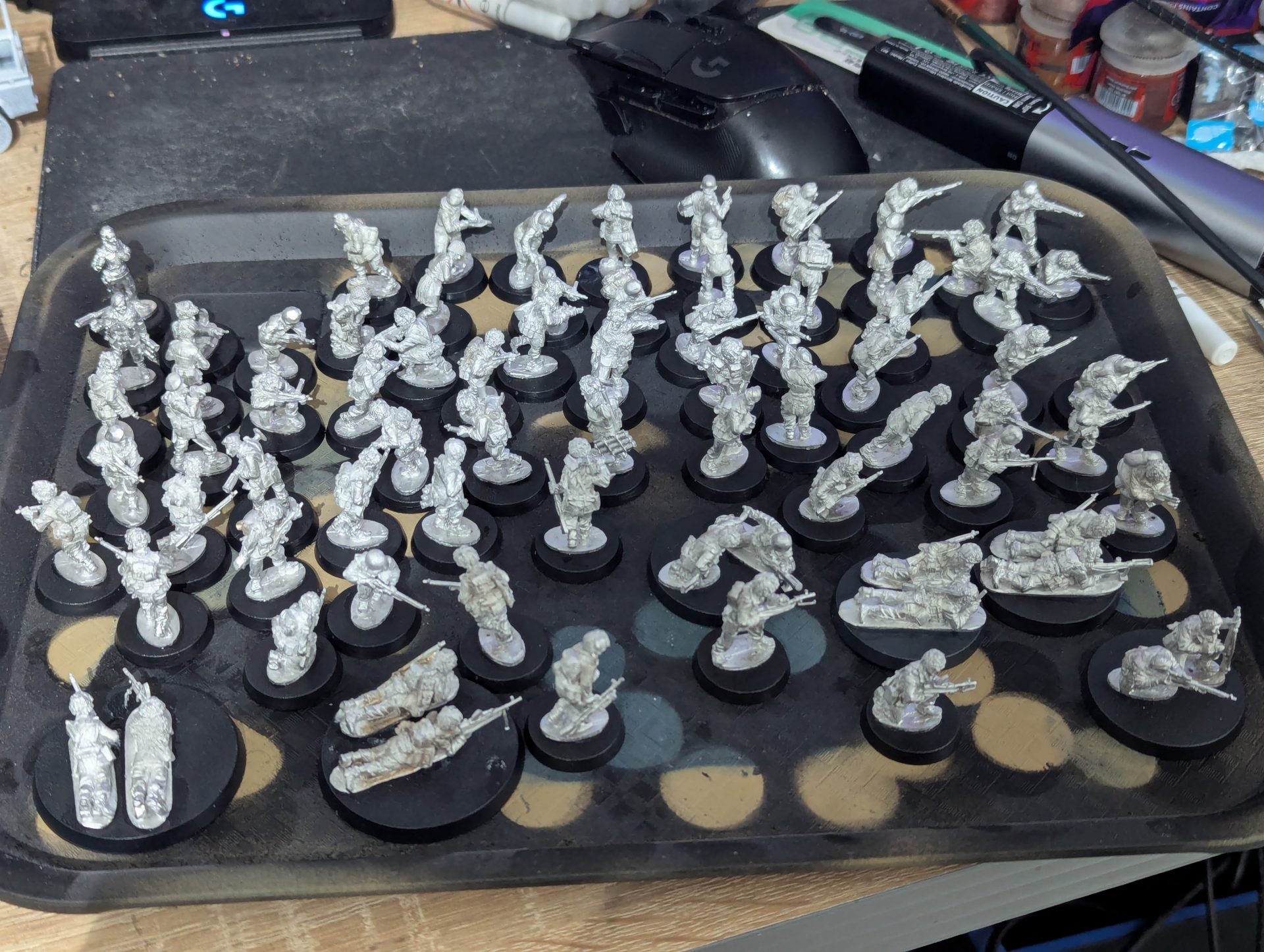
With our armoured sorted and two of the three Para platoons being delivered by the Dastardly Regular Opponent/Ally, my part in this escapade was to prepare the final British Airborne platoon. For this, I’d be using the rather excellent Paul Hicks sculpts from the two Kickstarters they ran (Arnhem Heroes 1 and Arnhem Heroes 2) that Empress Miniatures ran. Now, technically, these figures aren’t 100% suitable for D-Day; for example, the Sten Mk V wasn’t particularly common on D-Day (although a few people, such as the Glider troops at Pegasus did receive them) but the collection is packed full of them. I bought Deal 1 in both sets, focusing on the basic infantry figures for each release (I don’t play Bolt Action, so I have little need for the larger support weapons), but also added a few additional packs (mostly expanding the riflemen and Bren guns that all British Airborne need). I also picked up the glider pilots from Arnhem Heroes 2 – I have always had an interest in the Glider Pilots since seeing them as a unit in Flames of War, and seeing the cool and unusual weapons among the equipment, I just had to include them.
Overall, I ended up with a pretty handy force. Three sections of regular Paras (including the option to have a second Bren gun team in one of them), with an additional section built around the Glider Pilots (and an added LMG). The Platoon Command (two senior leaders) and integrated sniper team were filled out, but there are also four PIAT teams and two heroes (including a landlord and a VC winner). This then left me 11 additional figures with a mixture of weapons (including a Bren gun), so I could potentially add a fifth section if more bodies are needed – alternatively, I have the building block of an engineering section, including a flamethrower operator.
As someone who has gone full 3D printing for my hobby, it takes a lot for me to invest in metal figures anymore. However, Paul Hicks sculpts are some of the exceptions. Each figure feels unique, with subtle differences in body and face that you often miss with digital sculpting. There is also a weight to them – not physical weight, but the feeling of weight to the clothing and in the poses that few manage to capture digitally.
While I wax lyrical about the quality of the sculpts, much of the extra equipment (such as the 6pdr) did drive me to drink. The 6pdr gun and Vickers are both metal assemblies, and frankly, I had an awful time with them. There didn’t seem to be any guide marks or slots for pieces to fit into, meaning that attaching parts in place has either very little material to glue together or so much space for things to slide back and forth. Frankly, I think next time I would still buy the Empress crew (because the sculpts are fantastic) but replace the Anti-Tank guns with W3Gaming’s offerings – I think I will probably do this with the jeeps, getting crew from Empress (including their versions on foot with the Vickers K) but then printing my own vehicles.
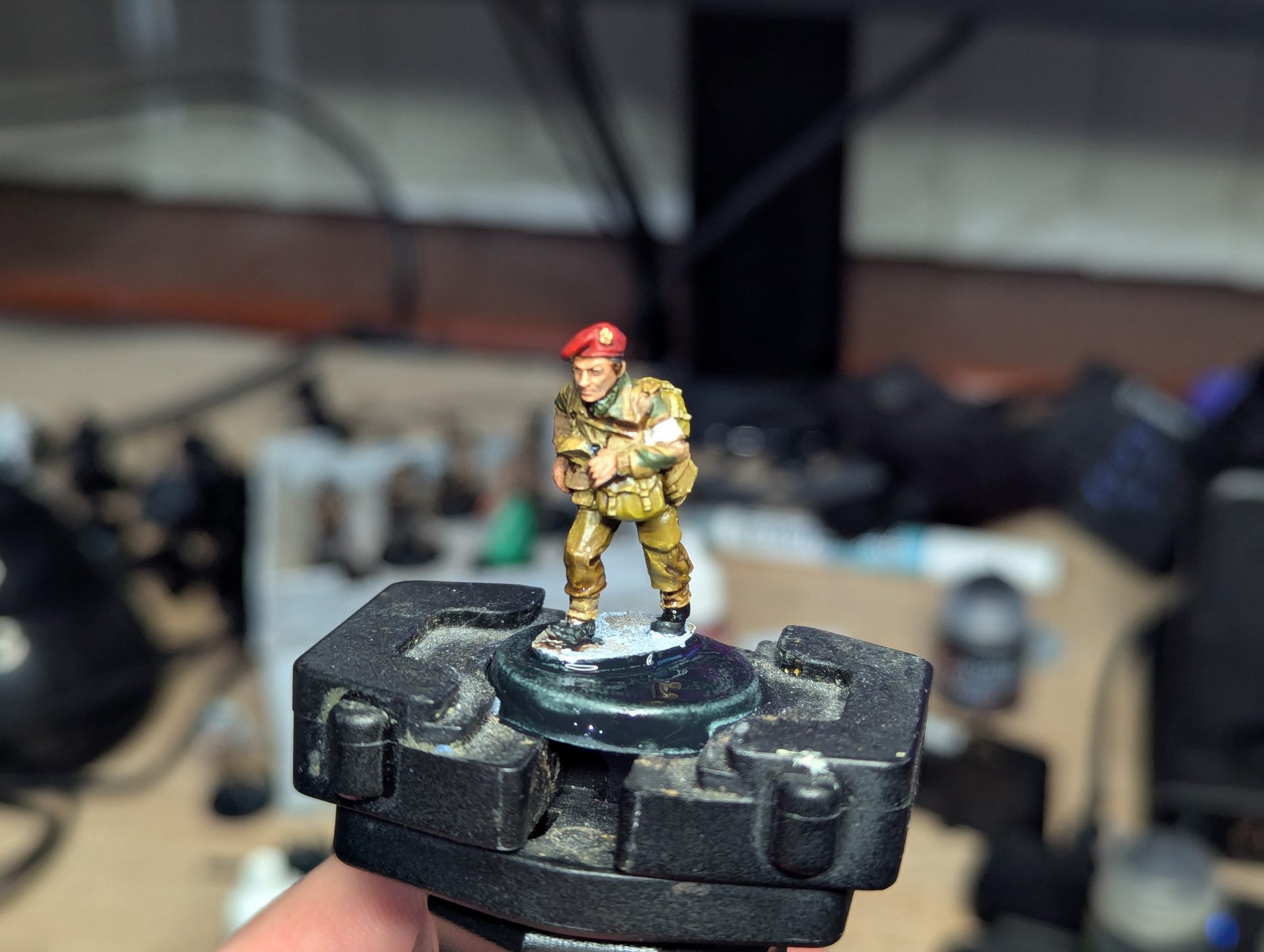
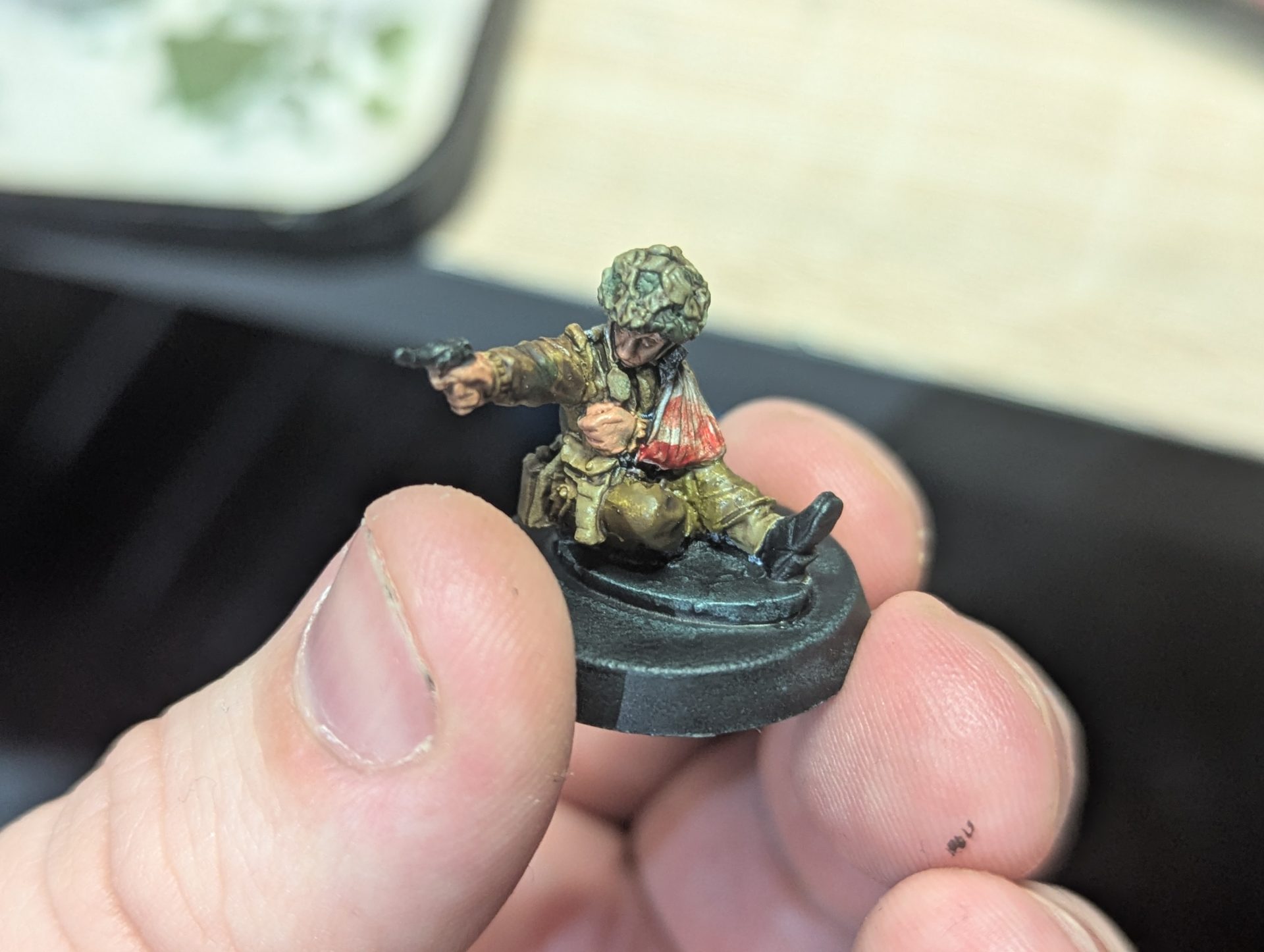
Painting-wise, I went with a slightly modified version of the scheme I used back in 2021 to paint up the first of my WW2 British Infantry. The only major change was the colours I used for the metal, as I am slowly moving away from GW paints toward Army Painter Fanatic paints.
- Khaki Grey (Vallejo 880): Denison Smock basecoat
- Dark Green (Vallejo 893): Denison Smock camouflage, helmet and neckscarf
- German Camo Medium Brown (Vallejo 826): Denison Smock camouflage
- English Uniform Brown (Vallejo 921): Trousers and canteen
- Russian Uniform Green (Vallejo 924): Helmet camo strips, PIAT, mortars, guns, Respirator Bag
- Scarlett Red (Vallejo 72.012): Beret
- Khaki (Vallejo 988): Helmet camo strips, gaiters, webbing and backpack
- Army Painter Fanatic Plate Metal: Metal pieces – Base colours for gun metal
- GW Rhinox Hide: Rifle Wood (although I will vary this to have a mix of looks)
As for the painting experience, it was lovely coming back to this style of figure – it’s been a while since I picked up a traditionally sculpted figure, and there are definitely differences between painting 3D printed resin and prepared metals. I don’t think either is necessarily better, but each feels different, and I honestly found painting the metals quite relaxing, with big details that were easy to paint but still with smaller pieces for the wash to catch. In addition, I managed to find a good routine, one that worked with a massive batch size of ten (a full section), working through colour by colour before having a final touch-up phase. It was relaxed enough that I could do it late at night while watching some YouTube, and it reminded me how much I actually enjoy painting figures and seeing the final result.
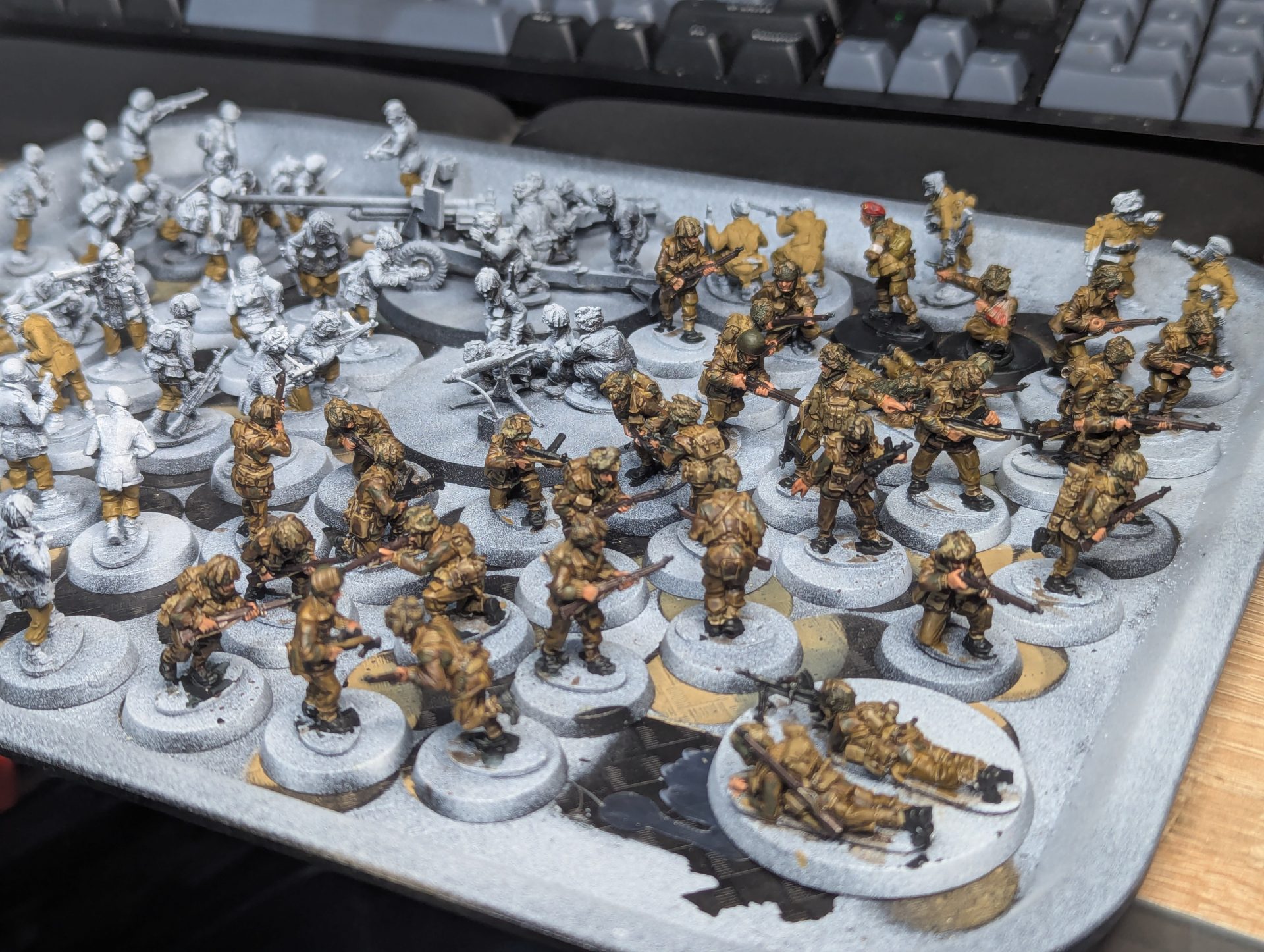
Overall, I felt like I was doing relatively well as we came into the final week before the big day. Thanks to the painting process being relatively quick and those mad 10-man batches, I managed to average a section an evening. However, real life threw a wrench into my personal plans, giving me several evenings where I didn’t have the time (or desire to paint). Worse, the wrench kept going and slammed into the overall planning. We had several people drop out, reducing us to only four players (all of whom were the various Regular Opponents). Combine that with us having not playtested the map or scenario, and the fact that everyone was still getting big chunks of prep the night before, led to me realising that, frankly, I was reaching a stage where I was dragging myself around, going through the motions, and not actually that excited about the idea of gaming. Combine this with real-life stress, and there was only really one proper course of action.
I made the call and dropped out.
Not what I really wanted to do (I usually very much enjoy my wargaming time with friends), but sometimes you can be trying too hard to make the fun and ignore what you actually need. I ended up having a far more relaxed day than planned, a chance to sit back and gather myself.
And that’s it. No game day, no tales of daring do, not even any photos of finished and based models. I had to put the project aside for a moment, moving on to take a look at my upcoming Necromunda campaign (there is a printed vehicle waiting for assembly) while also still working away on all things Ultramodern.
However, things are not all that bad. The decision to delay the game has given all of us all the time to get things ready, to plan and prepare. Of course, we did need to pick an actual date… and then we realised that this year June 6th falls on a Saturday. The Dastardly Regular Opponents and I have pencilled that in the calendar, and I intend to have all my figures painted and ready by then. Combine that with more time to get players ready (and give them time to make sure they can attend), and we should be able to see a company of British Paras (accompanied by their light tanks) defending against the German offensive.


Leave a Reply